
About Phoenix
Phoenix Neurofeedback and Mental Health Center was created to provide mental health care that brings together the science of the brain and the complexity of the human experience.
We specialize in psychotherapy, trauma-informed treatment, neurofeedback, nervous-system regulation, and culturally responsive care.
We recognize that emotional health does not develop separately from culture, family, relationships, trauma, community, spirituality, or identity. These experiences matter—and they deserve to have a place in treatment.
Our goal is not simply to reduce symptoms. We want to help people develop a deeper understanding of themselves, strengthen their capacity for self-regulation, and create sustainable change.
At Phoenix, treatment begins with the individual.
Regulation is the gateway. Awareness is the path. Transformation is inevitable.

FOUNDER | CLINICAL DIRECTOR | NEUROFEEDBACK EDUCATOR
Meet Djara E. Hampton, MSW, LICSW
Trauma-Informed Psychotherapist | Neurofeedback Specialist | Authorized BEE Medic Training Partner
I believe healing becomes possible when the nervous system no longer has to spend all of its energy surviving.
I am Djara Hampton, a Massachusetts Licensed Independent Clinical Social Worker and the founder of Phoenix Neurofeedback & Mental Health Center. My work brings together trauma-informed psychotherapy, brain-based neurofeedback, cultural understanding, and compassionate human connection to help people move beyond chronic stress, emotional overwhelm, and survival-mode living.
For more than 15 years, I have worked with individuals and families across community mental health, crisis services, child and family support, clinical supervision, and outpatient psychotherapy. Throughout that work, one truth has remained constant: people are not broken. Their minds and bodies are often responding intelligently to experiences that required them to adapt.
Regulation is the gateway. Awareness is the path. Transformation is inevitable.
My professional Journey
My professional foundation began with a Bachelor of Arts in Psychology from the University of Massachusetts Boston, followed by a Master of Social Work from Boston University. I am independently licensed to practice clinical social work in Massachusetts and have devoted my career to supporting people affected by trauma, anxiety, emotional dysregulation, family stress, and complex life circumstances.
My experience includes psychiatric crisis assessment and intervention, community-based mental health services, child and family stabilization, outpatient psychotherapy, case management, and clinical supervision. I have worked with people navigating urgent mental health concerns, significant transitions, challenging family dynamics, barriers to care, and the lasting effects of difficult life experiences.
My clinical work has also included leadership and supervision within the Cape Verdean Association of Brockton, where culturally responsive care, advocacy, and meaningful access to services are central to supporting the community.
These experiences taught me that healing cannot be reduced to a diagnosis, a symptom checklist, or a single technique. Effective care must consider the whole person: their nervous system, relationships, cultural identity, history, environment, strengths, and hopes for the future.
Tell them struggles you’ve faced and how you figured out the solution. Or talk about whatever you want here. This can be a showcase area to describe one of your movements.
A culturally responsive approach to healing
As a Cape Verdean immigrant and multilingual clinician, I understand that culture shapes how we experience distress, ask for support, understand family responsibility, and make meaning of healing. I also understand that many people have learned to carry pain quietly when traditional mental health spaces have not fully recognized their experiences.
I offer care with sensitivity to immigration, identity, racial and cultural stress, intergenerational patterns, belonging, and the practical realities that influence emotional well-being. My goal is to create a space where clients feel respected, understood, and free to bring their full selves into the therapeutic process.
Languages: English, Cape Verdean Creole, Spanish, and Portuguese.

Why Neurofeedback Became Central to my Work
Many people understand their experiences intellectually and still find that their bodies remain tense, reactive, exhausted, or constantly on alert. That is because insight alone does not always resolve patterns rooted in nervous-system dysregulation.
Neurofeedback adds another dimension to the healing process. It uses information about brain activity to support the brain’s capacity for self-regulation. Within an individualized treatment plan, neurofeedback may complement psychotherapy by helping clients develop greater stability, flexibility, and awareness of their internal experience.
My commitment to neurofeedback is both professional and deeply personal. My own experience with nervous-system healing strengthened my understanding of how transformative it can be when a person begins to feel safer, more grounded, and more connected to themselves. That lived understanding informs the compassion, pacing, and respect I bring to every therapeutic relationship.
Training in Othmer Method-informed neurofeedback
My neurofeedback practice is informed by the Othmer Method approach, which emphasizes careful clinical observation, individualized training, nervous-system regulation, and responsiveness to each person’s unique presentation.
My work incorporates Infra-Low Frequency neurofeedback and includes advanced Alpha-Theta training completed through EEG Info. In October 2025, I completed EEG Info’s Alpha Theta clinical practicum with instructor Evvy Shapero. The course focused on clinical discussion, hands-on two-channel Alpha-Theta practice, the history of the approach, its relationship to meditative states, and experiential learning. My record of course completion bears the name of Siegfried Othmer, PhD.
Depending on the individual’s needs and the clinical context, my approach may include Infra-Low Frequency training, Alpha-Theta neurofeedback, and Synchrony-oriented approaches. These methods are integrated thoughtfully with psychotherapy rather than presented as a substitute for clinical judgment or individualized care.
Professional training and educational credentials
My professional development reflects an ongoing commitment to evidence-informed care, practical clinical skill, and a deeper understanding of trauma, the nervous system, and the communities I serve.
Education and licensure
- Master of Social Work, Boston University, 2015.
- Bachelor of Arts in Psychology, University of Massachusetts Boston, 2004.
- Licensed Independent Clinical Social Worker, Commonwealth of Massachusetts.
Neurofeedback training and professional education
- Advanced Alpha Theta neurofeedback practicum, EEG Info, October 2025; certificate of course completion.
- Clinical application of Infra-Low Frequency, Alpha-Theta, and Synchrony-oriented neurofeedback approaches.
- Participation in BEE Medic's neurofeedback educator and training-partner community.
- Authorized BEE Medic Training Partner, confirmed in May 2026.
Additional verified training and continuing education
- Case Management Certificate, Boston University's Center for Aging and Disability Education and Research; 19 hours of training in aging and disabilities, completed in 2019.
- 37th Annual Boston Trauma Conference, Trauma Research Foundation; documented participation in continuing-education activities on May 28 and May 29, 2026.
- A Firefighter's Life, National Volunteer Fire Council and Firefighter Behavioral Health Alliance; completed specialized education in firefighter and emergency-responder behavioral health.
Additional areas of professional training
My professional background also includes training and experience in Cognitive Behavioral Therapy, Dialectical Behavior Therapy-informed interventions, motivational interviewing, trauma-informed care, family systems, family group conferencing, crisis assessment, suicide-risk and safety planning, case management, diversity awareness, and culturally responsive clinical practice.
Supporting firefighters and first responders
Firefighters, emergency medical personnel, and other first responders frequently work in environments that require intense focus, rapid decisions, and repeated exposure to distressing events. Over time, those demands can affect sleep, relationships, emotional regulation, physical well-being, and a person’s sense of safety.
I completed A Firefighter’s Life, a professional training associated with the National Volunteer Fire Council and the Firefighter Behavioral Health Alliance. This education strengthened my understanding of the culture, occupational pressures, and behavioral health needs of firefighters and emergency responders.
At Phoenix, I welcome opportunities to support first responders through culturally respectful, trauma-informed care that recognizes both the demands of the work and the importance of restoring nervous-system balance.
Speaking, teaching, and professional collaboration
I am passionate about helping clinicians understand how neurofeedback can complement trauma-informed psychotherapy and support more responsive care. I have presented internationally on the relationship between personal healing, nervous-system regulation, and the clinical application of neurofeedback in trauma treatment.
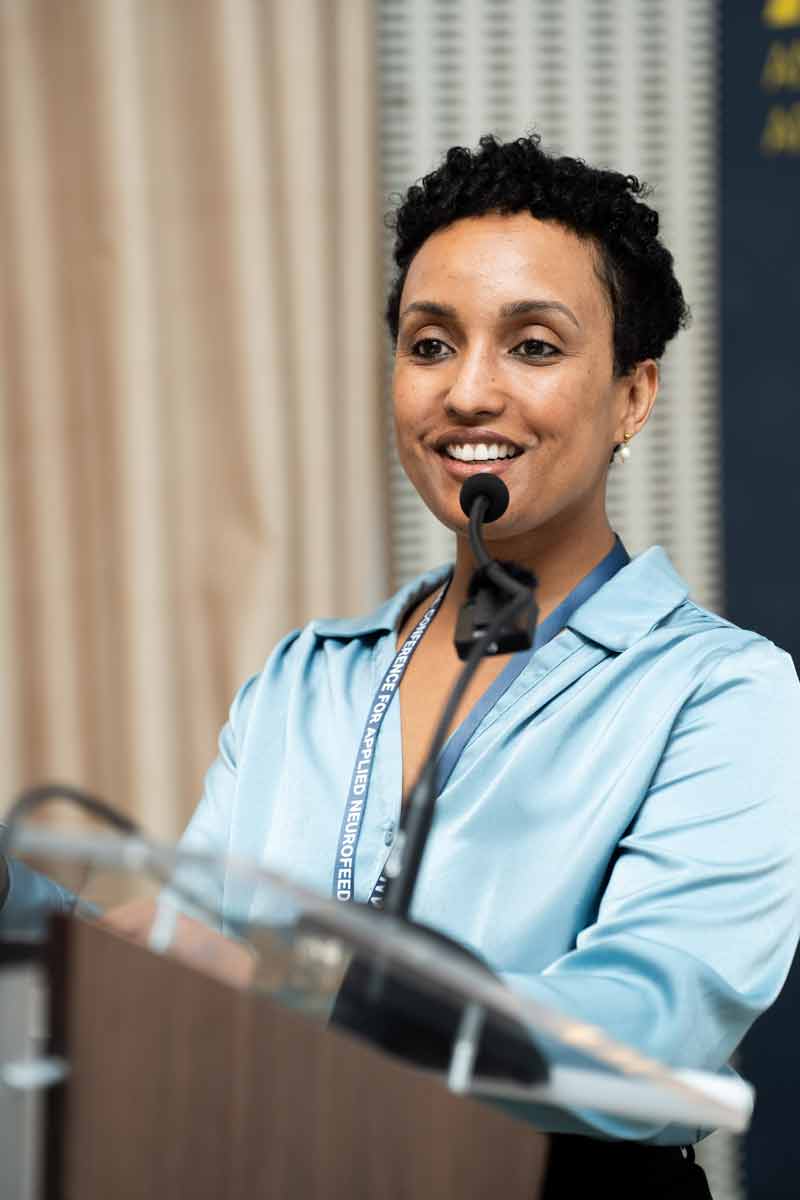
My presentation at the Annual Conference for Applied Neurofeedback (ACAN) in Croatia explored how neurofeedback can serve as a bridge between lived experience and clinical practice, with particular attention to trauma, Alpha-Theta training, Synchrony, emotional regulation, and the integration of psychotherapy.
I am also an Authorized BEE Medic Training Partner and am listed among BEE Medic’s neurofeedback educators. Through Phoenix Neurofeedback & Mental Health Center, I am developing future in-person training opportunities for qualified mental health and healthcare professionals who want to responsibly integrate neurofeedback into their clinical practices.
How I approach the healing process
I do not believe therapy should ask people to simply manage symptoms while remaining disconnected from their own bodies, needs, and capacity for change. My approach is collaborative, compassionate, and grounded in the understanding that meaningful healing often requires both insight and regulation.
Depending on your needs, our work may include trauma-informed psychotherapy, Cognitive Behavioral Therapy, mindfulness, emotional-awareness practices, nervous-system education, somatic awareness, and individualized neurofeedback.
Together, we can explore the patterns that developed to protect you, strengthen your ability to respond rather than react, and create more room for clarity, connection, and intentional change.

Who I Support
I work with people who may be navigating:
- Trauma, post-traumatic stress, and difficult life experiences.
- Anxiety, chronic stress, emotional overwhelm, and nervous-system dysregulation.
- Depression, self-worth concerns, grief, and major life transitions.
- Relationship challenges, family stress, and longstanding protective patterns.
- Sleep difficulties, attention concerns, and the impact of persistent hypervigilance.
- Cultural, immigration-related, racial-identity, or intergenerational stress.
- The occupational and emotional demands experienced by firefighters and first responders.
Begin your next chapter
Healing does not require you to become someone else. It begins with creating the conditions that allow your nervous system, your mind, and your sense of self to move toward greater safety and connection.
Whether you are seeking therapy, exploring neurofeedback, or interested in future professional training, I invite you to connect with Phoenix Neurofeedback & Mental Health Center.
Source and evidence reference
The public copy is based on Djara’s professional resumes, publicly indexed professional profiles, official organizational listings, and documentary evidence in her email. The source list below is intended for the website developer and should not be displayed verbatim as a public bibliography.
Djara Hampton’s publicly indexed LinkedIn profile
https://www.linkedin.com/in/djara-hampton-msw-licsw-b0880470
BEE Medic Education: public lecturer listing
https://beemedic.com/en/education
BEE Medic U.S. training partners
https://us.beemedic.com/partners
EEG Info: advanced neurofeedback practicum courses
https://www.eeginfo.com/courses/practicum-weekends.jsp
EEG Info: Othmer Method certification requirements
https://www.cws.eeginfo.com/othmer-method-neurofeedback-certification/requirements.jsp
National Volunteer Fire Council: behavioral-health professionals
Helping Responders in Need: Information for Behavioral Health Professionals
Djara Hampton’s Psychology Today professional listing
https://www.psychologytoday.com/us/therapists/djara-e-hampton-taunton-ma/837811
Cape Verdean Association of Brockton: staff and clinical supervision
https://www.cvassociation.org/staff